A Rare Lunar Mineral Could Power Humanity for Thousands of Years
A Rare Lunar Mineral Could Power Humanity for Thousands of Years
The renewed global race to the Moon is being driven by more than scientific curiosity or national prestige. One major reason is energy—specifically, the potential of Helium-3, a rare isotope that could someday revolutionize clean power generation on Earth.
China’s Chang’e-5 mission recently returned lunar samples containing a newly identified mineral called Changesite-(Y). Chinese scientists describe it as a transparent, colorless, column-shaped crystal, incredibly tiny—about one-tenth the width of a human hair. Despite its microscopic size, this mineral has captured worldwide attention because it contains Helium-3.
Helium-3 has long been considered a promising fuel source for future nuclear fusion reactors. Unlike traditional fusion fuels such as deuterium and tritium, Helium-3 fusion produces far fewer radioactive byproducts, making it a potentially cleaner and safer energy source.
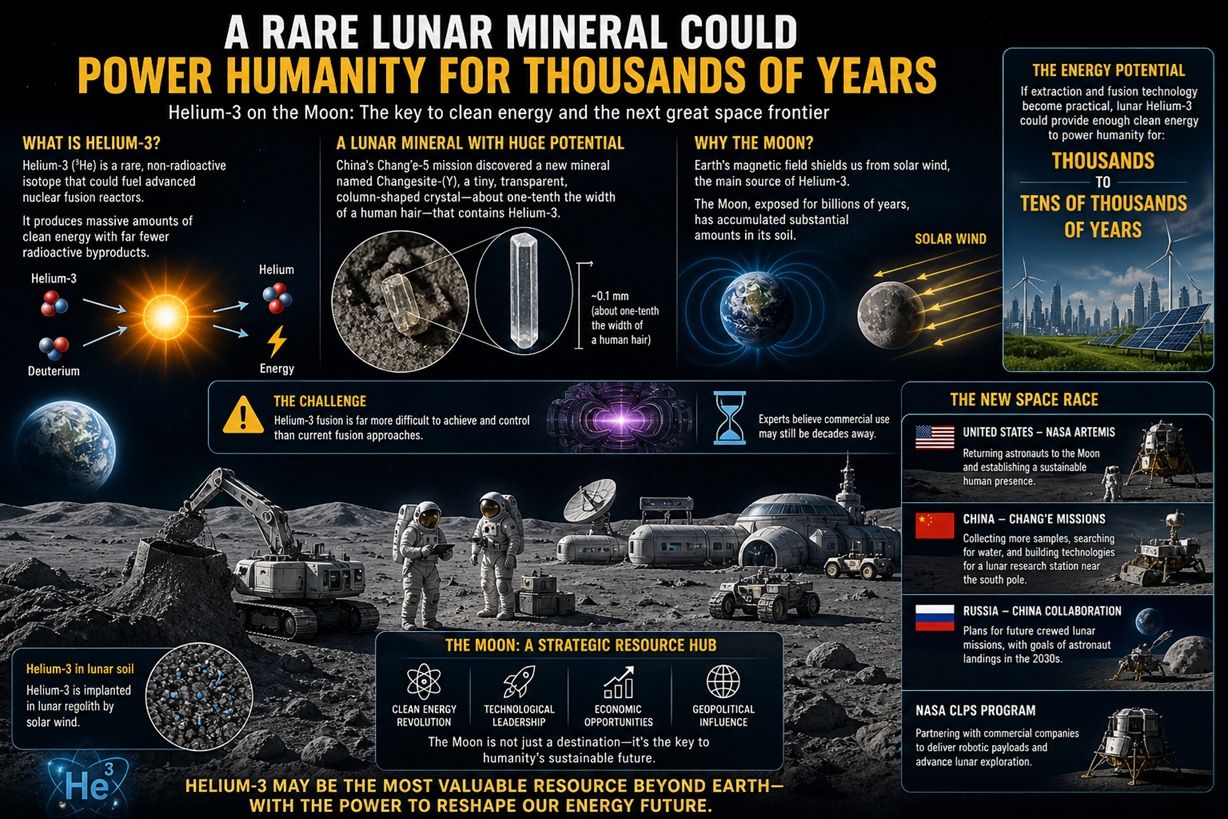
Scientists have known since the Apollo missions that the Moon’s surface contains deposits of Helium-3. Because Earth’s magnetic field shields our planet from solar wind—the primary source of this isotope—Helium-3 is extremely scarce here. The Moon, however, has been directly exposed to solar wind for billions of years, allowing substantial quantities to accumulate in its soil.
If extraction and fusion technology become practical, lunar Helium-3 could theoretically provide enough clean energy to meet humanity’s needs for thousands, or even tens of thousands, of years.
The challenge remains technological. Helium-3 fusion is far more difficult to achieve and control than current fusion approaches, and experts believe commercial use may still be decades away. Nevertheless, the enormous long-term potential is motivating major powers to invest heavily in lunar exploration.
For the United States, NASA’s Artemis program represents a strategic effort to return astronauts to the Moon and establish a sustainable presence there. For China, upcoming Chang’e missions aim to collect additional samples, search for water resources, and test technologies needed for a long-term lunar research station near the Moon’s south pole.
China is also reportedly collaborating with Russia on future crewed lunar missions, with ambitions that may culminate in astronaut landings during the 2030s.
Meanwhile, NASA continues advancing its Artemis missions alongside commercial partnerships through its Commercial Lunar Payload Services (CLPS) program, which uses private companies to help deliver robotic payloads to the Moon’s surface.
As competition intensifies, the Moon is increasingly viewed not just as a destination for exploration, but as a strategic resource hub—one that may hold the key to the future of clean energy, technological leadership, and geopolitical influence.
In this new space race, Helium-3 may prove to be one of the most valuable resources beyond Earth, with the potential to reshape global energy systems in ways previously unimaginable.