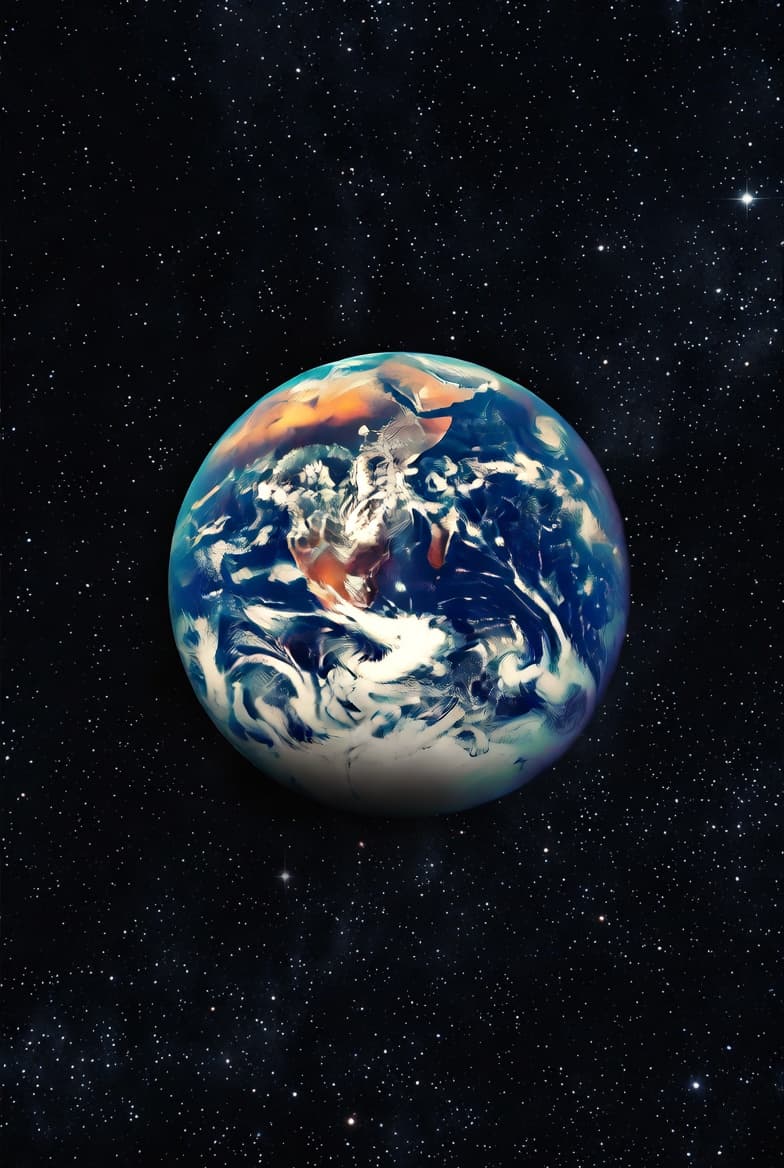
The Five Great Mass Extinctions in Earth’s History
The Five Great Mass Extinctions in Earth’s History
Why Do Mass Extinctions Happen?
Journey back through Earth’s deep past to explore the five terrifying mass extinction events that reshaped life on our planet—and to uncover whether humanity may now be triggering a sixth.
What Is a Mass Extinction?
A mass extinction is a catastrophic event during which a vast proportion of Earth’s species disappear within a relatively short geological timeframe. Over Earth’s 4.6-billion-year history, scientists recognize five major mass extinctions, all occurring during the Phanerozoic Eon—the period beginning roughly 541 million years ago when abundant complex life flourished.
Each of these devastating biological collapses nearly brought life to the brink of annihilation. Yet every time, Earth proved remarkably resilient, eventually recovering and giving rise to new evolutionary eras.
1. The Ordovician–Silurian Extinction (Approximately 440–450 Million Years Ago)
The first major mass extinction struck during the late Ordovician Period. This event eliminated around 17% of biological families, 50% of genera, and an estimated 85% of marine species, making it the second-largest extinction in terms of species loss.
At this time, life was largely concentrated in the oceans. Nearly half of all marine genera vanished. Many scientists believe the leading cause may have been dramatic global cooling, potentially triggered by falling atmospheric carbon dioxide levels, perhaps associated with intense glaciation. Some speculative theories even suggest gamma-ray bursts may have contributed to atmospheric disruption.
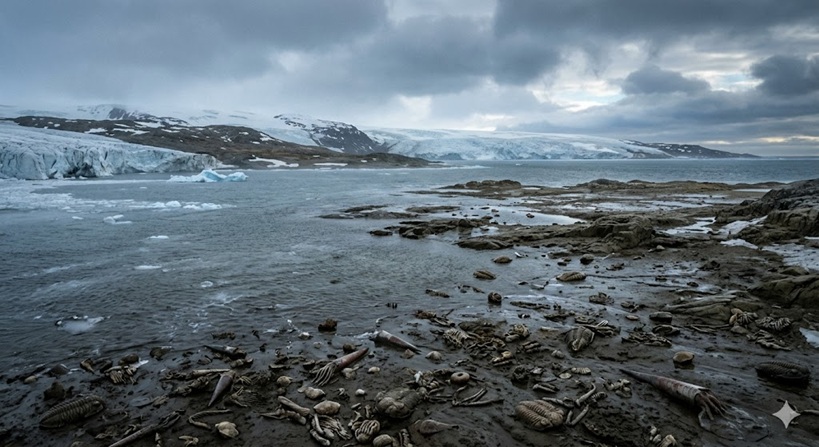
As glaciers expanded, sea levels dropped significantly, destroying shallow marine habitats where much biodiversity thrived. Later, as glaciers melted, sea levels rose again, radically reshaping ecosystems.
Despite the devastation, surviving species eventually adapted and diversified, ushering in a new chapter of evolutionary history.
2. The Late Devonian Extinction (Approximately 360 Million Years Ago)
Unlike a single catastrophic event, the Devonian extinction appears to have unfolded over a prolonged period—possibly as long as 20 million years.
Before this crisis, Earth’s oceans teemed with coral reefs and fish diversity, while primitive plants and early insects were spreading across land.
Several factors may have contributed to this drawn-out extinction:
Massive asteroid impacts
Global cooling caused by widespread plant expansion reducing CO2
Oceanic anoxia (oxygen depletion in marine waters)
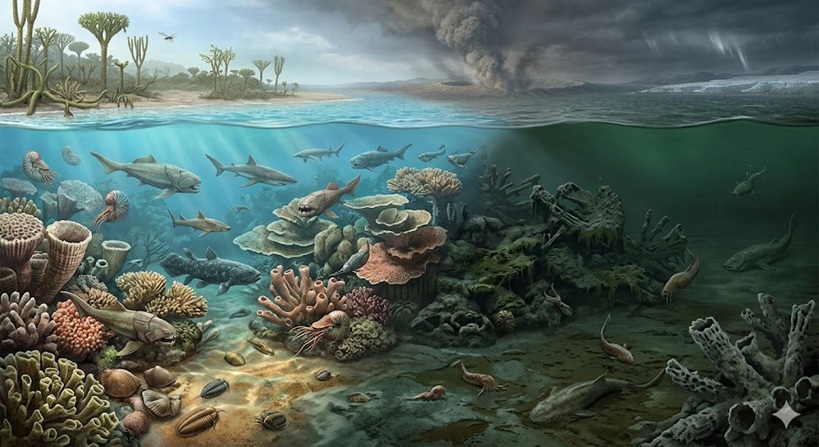
The collapse of coral reef systems was particularly devastating, as reefs served as biodiversity hotspots for marine life.
By the end of this extinction period:
About 19% of families disappeared
50% of genera vanished
Roughly 70% of species were lost
This event dramatically altered marine ecosystems and reshaped the trajectory of vertebrate evolution.
3. The Permian–Triassic Extinction (Approximately 252 Million Years Ago)
Known simply as “The Great Dying,” this was the most catastrophic extinction event in Earth’s history.
An astonishing:
96% of marine species
70% of terrestrial vertebrate species
were wiped out.
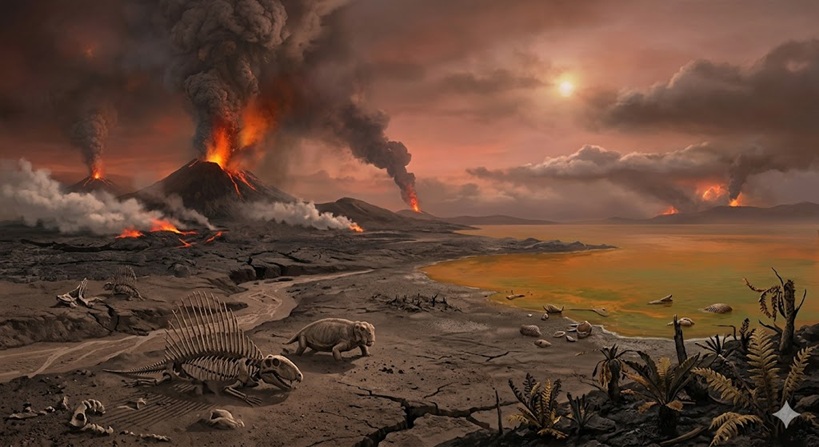
The leading culprit is believed to be massive volcanic eruptions in what is now Siberia, known as the Siberian Traps. These eruptions released enormous quantities of:
Carbon dioxide
Methane
Toxic gases
The result was runaway global warming, ocean acidification, widespread oxygen depletion, and ecological collapse.
Continental drift may also have intensified environmental instability, while some evidence suggests asteroid impacts may have compounded the disaster.
This extinction nearly reset life on Earth entirely. Recovery took millions of years, with only small, resilient organisms surviving to repopulate the planet.
4. The Triassic–Jurassic Extinction (Approximately 199.6 Million Years Ago)
This extinction event marked the boundary between the Triassic and Jurassic periods and paved the way for the rise of dinosaurs.
Approximately:
23% of families
48% of genera
were lost.
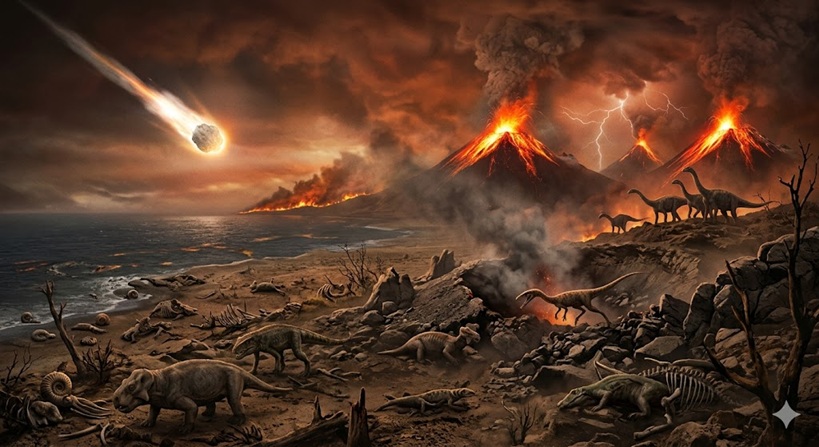
Although its precise cause remains debated, enormous volcanic eruptions associated with the breakup of the supercontinent Pangaea are considered a major factor. These eruptions likely caused rapid climate change, greenhouse warming, and ocean acidification.
Some scientists also point to asteroid impacts, such as the Manicouagan impact crater in Canada, as potential triggers.
With many dominant reptilian competitors eliminated, dinosaurs rapidly expanded to become Earth’s ruling land animals for the next 135 million years.
5. The Cretaceous–Paleogene Extinction (Approximately 66 Million Years Ago)
Perhaps the most famous extinction event, this catastrophe ended the reign of the dinosaurs.
Around:
17% of families
50% of genera
75% of species
disappeared.
The primary cause is widely accepted to be the Chicxulub asteroid impact near modern-day Mexico, which unleashed unimaginable destruction:
Global wildfires
Massive tsunamis
Atmospheric dust clouds blocking sunlight
Collapse of photosynthesis
Severe global cooling
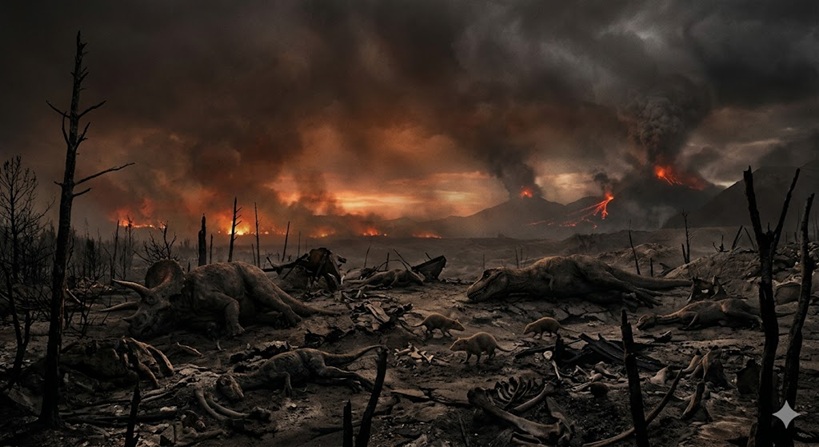
At the same time, volcanic activity in India’s Deccan Traps may have worsened environmental instability.
Non-avian dinosaurs were among the most prominent casualties, while mammals—previously small and relatively insignificant—were able to diversify and eventually dominate terrestrial ecosystems.
Why Do Mass Extinctions Occur?
Mass extinctions generally happen when ecosystems endure extreme, sustained environmental stress, often followed by sudden catastrophic shocks.
Scientists Allen and West proposed the “press-pulse” model:
Press: Long-term ecological stress (climate shifts, sea-level changes, atmospheric disruption)
Pulse: Sudden disasters (asteroid impacts, volcanic eruptions)
Neither factor alone may always be sufficient, but together they can trigger global biological collapse.
Is There a Pattern?
Some researchers have suggested cyclical patterns to mass extinctions, proposing intervals of roughly:
26–30 million years
62 million years
Potential explanations include:
Galactic oscillations
Solar system movement through spiral arms
Geological cycles
However, evidence remains inconclusive, and many scientists remain skeptical of strict periodicity.
Are We Entering the Sixth Mass Extinction?
Unlike previous extinctions driven by natural forces, many scientists warn that today’s biodiversity crisis is largely human-driven.
Key factors include:
Climate change
Habitat destruction
Pollution
Overexploitation of resources
Ocean acidification
Invasive species
Current extinction rates are estimated to be thousands of times higher than natural background rates.
For the first time in Earth’s history, a single species—humanity—may be responsible for triggering a planetary-scale biological crisis.
If these trends continue unchecked, scientists fear the sixth mass extinction may already be underway.
Final Thoughts
Earth has survived five catastrophic biological resets, each one destroying dominant life forms and reshaping evolution.
But the sixth may be fundamentally different.
This time, the threat is not an asteroid, volcanic apocalypse, or ice age.
It is us.
Whether humanity can change course may determine not only the future of countless species—but our own survival as well.