The Railroad System and Its Historical Development
The Railroad System and Its Historical Development
The modern railroad system began in early 19th-century England and quickly transformed transportation, industry, and economic growth across the world.
The Birth of the Steam Locomotive
The first successful passenger steam locomotive was developed by George Stephenson, an English engineer who had previously worked in coal mines and was familiar with steam engines inspired by James Watt, William Murdoch, and Richard Trevithick.
Stephenson’s most famous locomotive, the Rocket, launched in 1830, became a major milestone in railroad history. It could carry 36 passengers at speeds of up to 30 miles per hour, an extraordinary achievement for its time.
In 1825, Stephenson also built the world’s first public railway line between Stockton-on-Tees and Darlington. This was followed in 1830 by the Liverpool-Manchester railway, which established regular passenger steam service.
Stephenson also promoted a standard rail gauge of 4 feet 8.5 inches, which later became the dominant railway standard in Europe and North America.
Railroads Expand to the United States
Inspired by British innovation, the United States rapidly adopted railroad technology.
In 1825, Colonel John Stevens built an experimental locomotive in Hoboken.
By 1827, American rail companies began importing British locomotives, including the Stourbridge Lion, one of the first commercial locomotives used in the U.S.
Soon, American engineers began designing their own models better suited to the country’s rougher terrain:
Tom Thumb by Peter Cooper
Best Friend of Charleston
John Bull
DeWitt Clinton
These early locomotives introduced improvements such as lighter construction, increased wheel systems, and stronger traction.
Industrial Growth and Railroad Expansion
Railroads became essential to America’s economic expansion during the 19th century.
They allowed:
Faster transportation of raw materials
Settlement of western territories
Growth of major industrial centers
Efficient troop and supply movement during the American Civil War
By the 1860s, the U.S. government prioritized the construction of a transcontinental railroad.
The Pacific Railroad Act authorized:
Central Pacific Railroad to build eastward from Sacramento
Union Pacific Railroad to build westward from Omaha
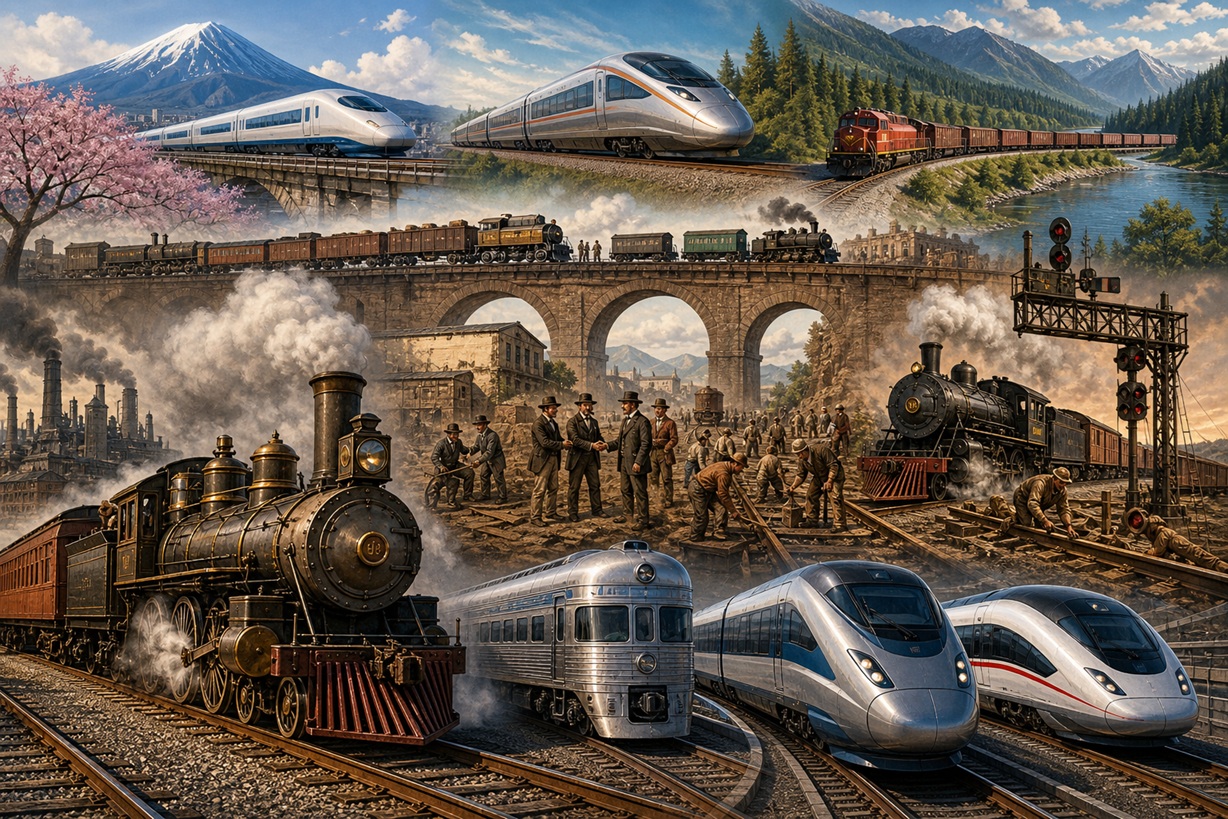
On May 10, 1869, the two lines met at Promontory, completing America’s first transcontinental railroad.
Safety Innovations
As rail travel expanded, safety became a priority.
Major innovations included:
Air brakes by George Westinghouse in 1869
Automatic couplers by Eli H. Janney
Automatic signal systems
Federal railroad safety regulations
These advancements significantly reduced accidents and improved operational efficiency.
Passenger Comfort and the Pullman Revolution
Early passenger cars were uncomfortable, open-air, and exposed to weather.
George Pullman revolutionized passenger rail by creating luxury sleeping cars with:
Upholstered seating
Private sleeping compartments
Heating
Improved sanitation
Hotel-style amenities
The Pullman Company became synonymous with luxury rail travel.
Transition from Steam to Electric and Diesel
For nearly a century, steam locomotives dominated rail transportation.
By the late 19th and early 20th centuries:
Electric rail systems emerged in urban areas
Diesel-electric locomotives improved efficiency
Railcars became faster, quieter, and cleaner
Notable innovations included:
Burlington Zephyr
Streamlined passenger trains
Electrified long-distance rail corridors
Competition and Modernization
In the mid-20th century, railroads faced competition from:
Automobiles
Buses
Airplanes
Freight trucking
To preserve passenger rail service, the U.S. established Amtrak in 1971.
Global Railroad Development
Railroads spread rapidly across the world:
Europe
France developed the TGV high-speed rail system
United Kingdom pioneered early railways
Orient Express became iconic
Asia
Japan introduced the Shinkansen in 1964
China expanded one of the world’s largest rail networks
Russia
Trans-Siberian Railway connected European Russia to Asia
Canada
Canadian Pacific Railway completed transcontinental service in 1885
Conclusion
From George Stephenson’s early steam engines to today’s high-speed electric trains, railroads have played a foundational role in shaping modern civilization.
They have:
Connected nations
Expanded commerce
Supported industrialization
Enabled migration
Reduced transportation costs
Continued to evolve as one of the safest and most efficient transportation systems in the world
Today, rail systems remain essential for both passenger travel and freight movement, while also offering environmentally sustainable alternatives for future transportation.